★ The RhinoArtisan Blog
ARTIFICIAL INTELLIGENCE · RHINO AND RHINOARTISAN
Build Your First AI Agent for Jewelry Manufacturing | Rhino + MCP
Book a demo with our teamOctober 15, 2026 · RhinoArtisan · News
Build Your First AI Agent for Jewelry Manufacturing with Rhino and MCP
What if an AI agent could manage your jewelry manufacturing orders while you focus on designing, creating, and growing your business?
Hi everyone,
Today, I want to share something I’ve been exploring for a while: how we can use AI agents to automate real tasks in our jewelry businesses.
We’ve talked a lot about artificial intelligence in jewelry design, but I believe one of the most exciting opportunities goes beyond creating jewelry. It’s about building intelligent systems that can help us manage our daily work.
And the best part? You don’t need to start with something complicated.
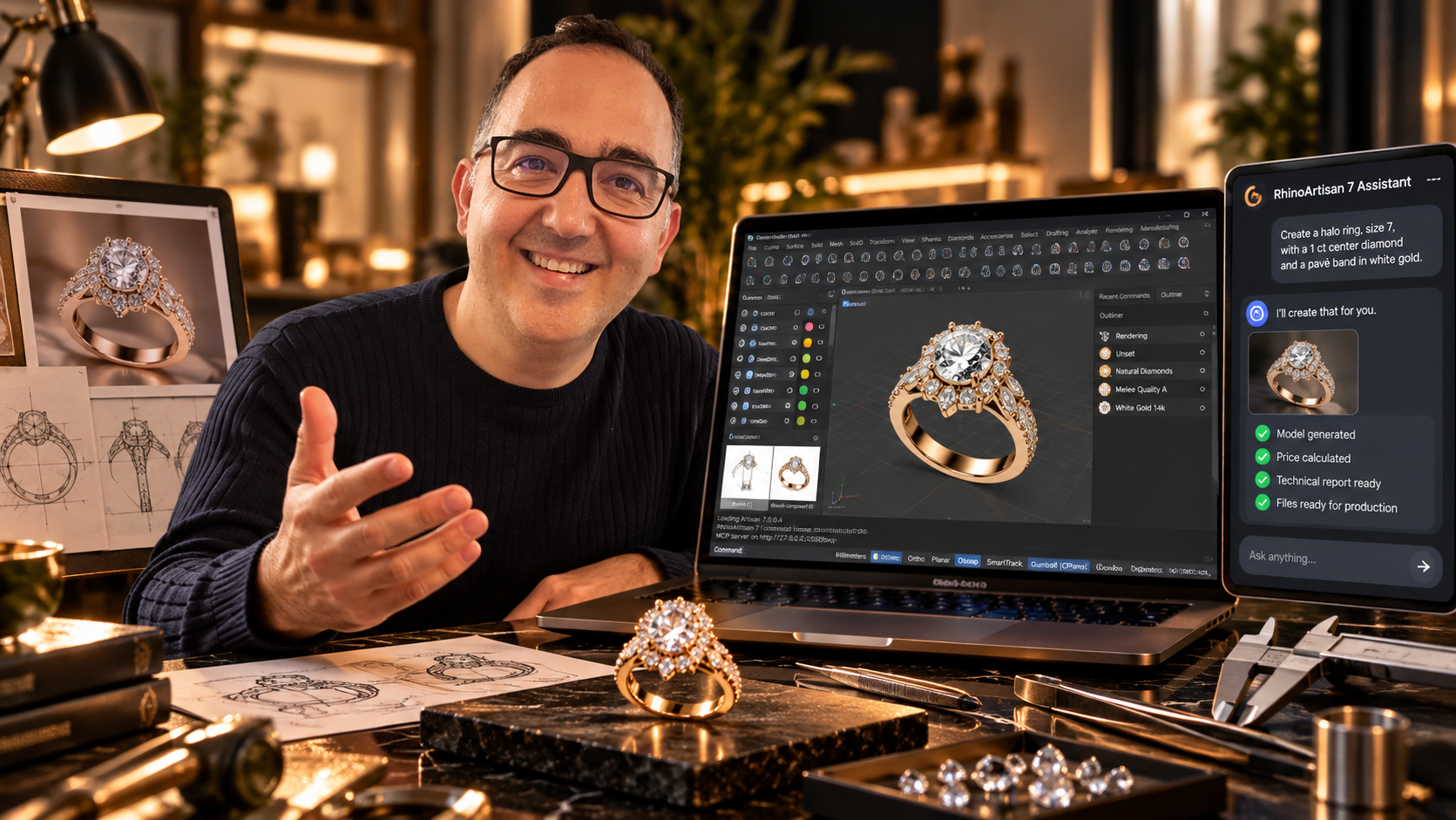
In this video, I’ll show you how to create your first AI agent, connect it to RhinoArtisan, and give it a real job in a jewelry manufacturing workflow.
From AI Assistants to AI Agents
Most of us are already familiar with AI assistants. We ask questions, request information, or generate content.
But AI agents take this a step further.
Instead of simply answering questions, an AI agent can use external tools, access information, follow instructions, make decisions within defined rules, and perform tasks on our behalf.
Imagine an agent that checks your production inbox, identifies new manufacturing orders, prepares the necessary files, organizes your production folders, and replies to your customers.
That’s exactly what we’re going to explore.
Connecting AI to RhinoArtisan with MCP
One of the technologies making this possible is MCP (Model Context Protocol).
MCP allows AI applications to communicate with external tools and services, including RhinoArtisan.
Think of it as a bridge between artificial intelligence and the software we use every day.
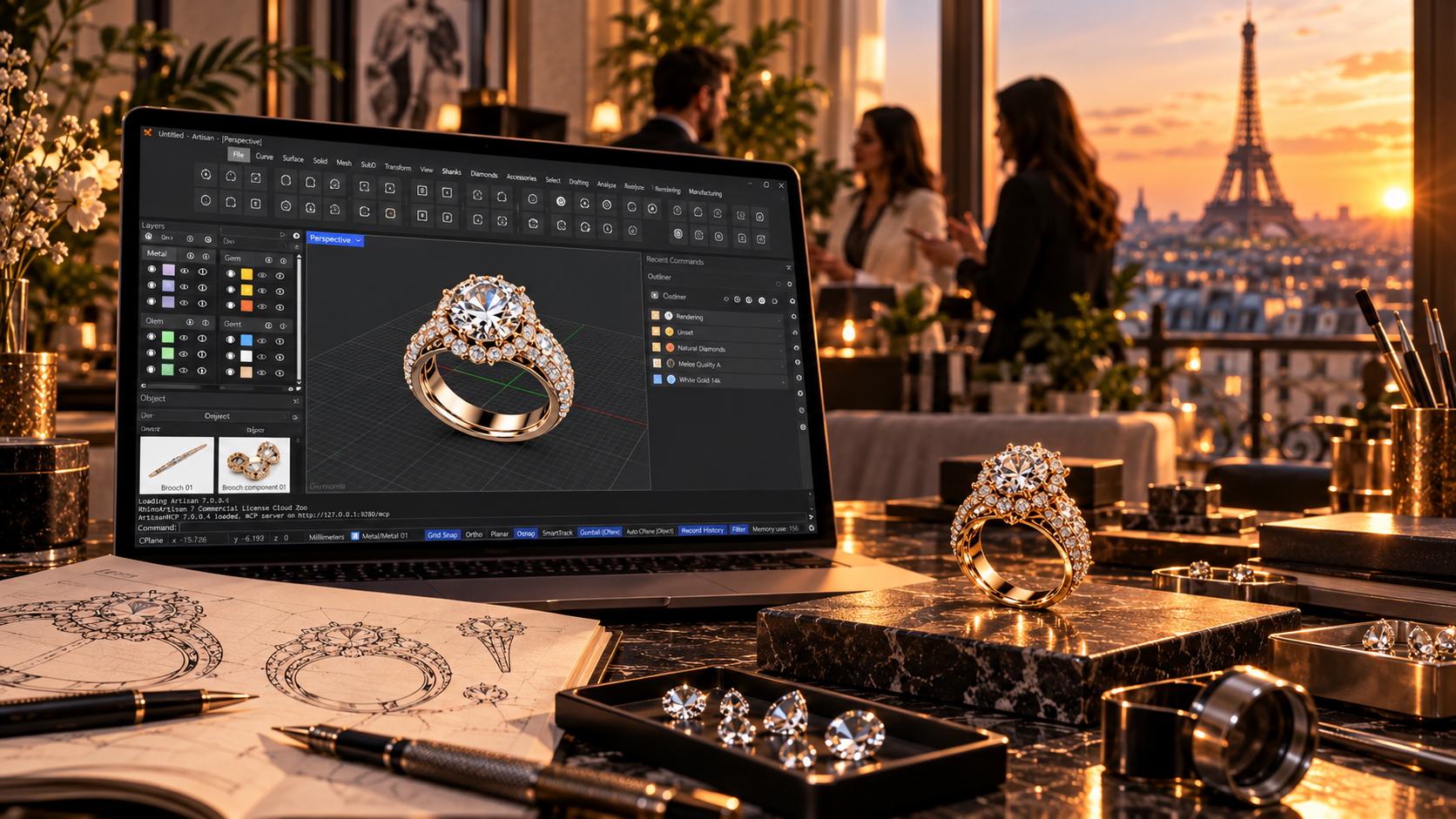
With RhinoArtisan’s MCP integration, AI agents can interact with jewelry design and manufacturing tools, opening the door to entirely new workflows.
And this is where things become particularly interesting.
We’re no longer talking only about using AI to help design jewelry. We’re talking about connecting design, manufacturing, and business operations.
Meet Our First Agent: 3D Print Manager
For this tutorial, we’ll use Grok Bot to create an agent called 3D Print Manager.
Its mission is simple: help manage incoming 3D printing orders for a jewelry workshop or manufacturing department.
We’ll teach our agent to:
- Check our production email and identify new 3D printing orders.
- Download customer attachments, including Rhino 3DM files.
- Connect to RhinoArtisan to analyze the jewelry models and prepare or repair production-ready STL files.
- Prepare the metal components only, excluding gemstones from the files intended for printing.
- Generate a preview image of each jewelry piece.
- Create a Technical Chart containing the model’s technical information.
- Organize the production files into folders, keeping the original model, STL, preview, and technical documentation together.
- Reply to the customer with confirmation and a detailed breakdown of the work completed.
We’ll configure the agent, define its responsibilities, and test the workflow with a real jewelry model.
The objective isn’t to create the most sophisticated agent in the world. It’s to build something practical that solves a real problem.
Why I Prefer Small, Specialized AI Agents
I currently use around 20 to 30 AI agents to help manage different areas of my business.
Some assist with publications, Instagram, LinkedIn, SEO, or organizing ideas and improvements for RhinoArtisan.
And I’ve learned something important along the way.
I prefer having multiple specialized agents rather than one enormous agent trying to do everything.
Each agent has a clear responsibility. It’s easier to understand, easier to improve, and easier to control.
If you’re just getting started, this would be my biggest recommendation: choose one repetitive task, create an agent to handle it, test it, and gradually expand its capabilities.
The tools themselves are secondary. Whether you use Grok Bot, OpenAI, Claude, or another platform, what really matters is understanding what you want to automate and defining how the agent should work.
And This Is Just the Beginning
Once our 3D Print Manager can receive and prepare orders, imagine what we could add next.
We could connect it to our ERP, calculate manufacturing costs, generate quotations, estimate production times, schedule deliveries, manage inventory, or coordinate workflows between sales, design, and manufacturing departments.
And why stop there?
Imagine having an entire team of specialized AI agents working together, helping you design, manufacture, sell, and manage your jewelry business.
You don’t need to build everything at once.
Start small. Solve one real problem. Make it work. And then keep improving.
For me, that’s one of the most exciting things about where AI is heading.
The future of artificial intelligence isn’t just about asking questions. It’s about getting things done.
Watch the Full Tutorial

In the video, I’ll walk you through the process of creating our first AI agent, explaining MCP, connecting RhinoArtisan, defining the agent’s responsibilities, and testing it with a real manufacturing workflow.
I hope it inspires you to start experimenting with your own ideas.
And I’d genuinely love to hear what you’re planning to build. What tasks would you like an AI agent to handle in your jewelry business?
Let me know in the comments!
Thank you for watching, and have a wonderful day!
Design it. Manufacture it. Sell it.
Try RhinoArtisan free for 15 days
Full access to every tool. No credit card required. Works with your existing Rhino installation.
Setup takes less than 2 minutes
Talk to us
Let's talk about what you want to achieve.
Book a free 30-minute one-to-one session with a RhinoArtisan specialist. Tell us about your work, your challenges and what you would like to achieve, and we'll help you find the best way forward.