Commands
Thickness
.png) Thickness
Thickness
With this command, you can see the thickness of an object at a point you choose. It’s a great tool to check if a creative design is printable on your 3D printer. Just pick a point on the point to analyse.
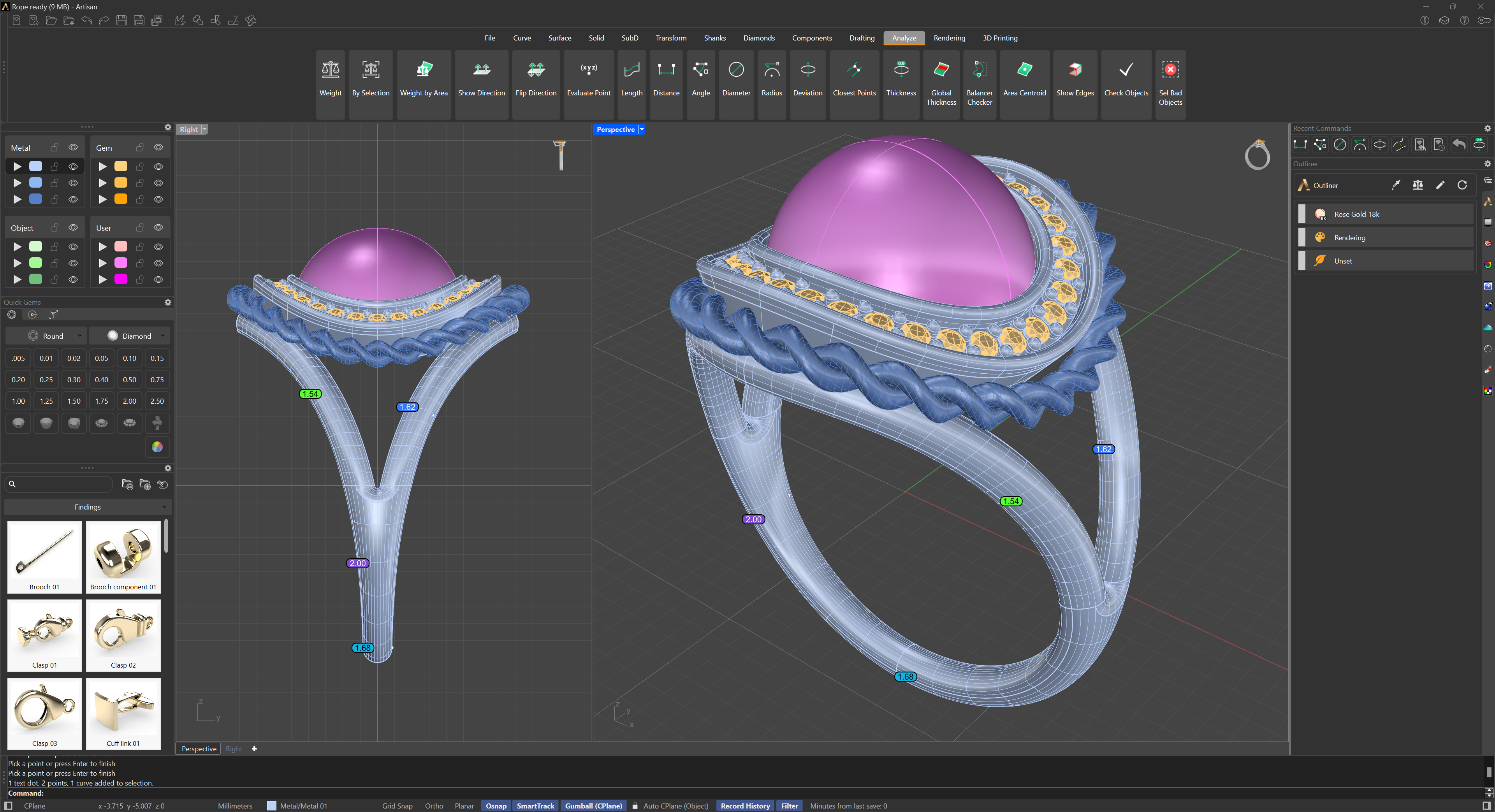
From a manufacturing standpoint, the thickness of a piece of jewelry is a critical factor that directly influences the production process and the quality of the final product.
Implications of thickness in jewelry manufacturing:
- Casting:
- Minimum thickness: A minimum thickness is necessary for the wax models to remain stable during investment and to prevent deformation during the casting process.
- Uniform thickness: A uniform thickness facilitates metal solidification and reduces the risk of porosity or bubbles in the cast piece.
- Thickness in critical areas: In areas with fine details or with settings, additional thickness is required to prevent breakage or deformation during finishing and polishing.
- Finishing:
- Polishing: Sufficient thickness allows for a bright and durable polish.
- Plating: Thickness influences the adhesion of gold, rhodium, or other precious metal platings.
- Engraving: Adequate thickness allows for deeper and more detailed engravings.
- Setting:
- Securing stones: Sufficient thickness ensures the security of precious and semi-precious stones, preventing them from falling out.
- Setting type: The thickness of prongs or pavé depends on the size and shape of the stone.
- Soldering:
- Strength of joints: Adequate thickness in soldering areas ensures the strength of the piece.
- Quality control:
- Measurements: Thickness is verified at various points of the piece to ensure it meets design specifications.
- Defect detection: Insufficient thickness can reveal defects such as porosity or cracks.
Benefits of calculating thickness at specific points with RhinoArtisan:
- Material optimization: It allows you to identify areas where thickness can be reduced without compromising strength or aesthetics, resulting in material savings and lower costs.
- Error reduction: By having a precise measurement of thickness, manufacturing errors are minimized, reducing the number of defective pieces and rework costs.
- Greater control over the process: It allows manufacturers to have greater control over the entire production process, from design to final finish.
- Improved product quality: By ensuring uniform and adequate thickness in all areas of the piece, a higher quality and more durable final product is obtained.